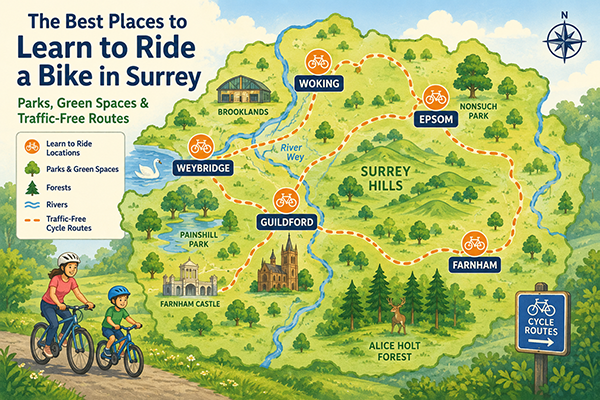
Learning to ride a bike is one of childhood's greatest achievements, but choosing the right…
Common Mistakes Parents Make When Teaching Cycling
Teaching your child to ride a bike can be an exciting milestone. But it can also be frustrating when progress doesn’t come as quickly as expected.
Often the biggest challenges come from small mistakes that unintentionally make learning harder.
Understanding these common issues can help make the process smoother and more enjoyable for both parent and child.
Starting With Stabilisers
One of the most common mistakes is relying on stabilisers for too long.
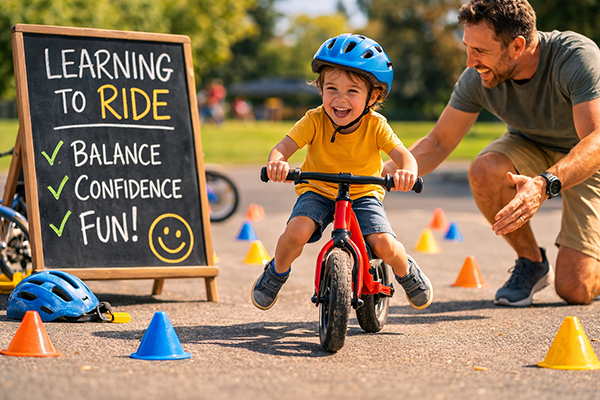
While stabilisers allow children to pedal straight away, they remove the need to balance the bike and can very often slow down learning to ride.
When stabilisers are eventually removed, children often struggle because the balancing skill hasn’t been developed.
Focusing on balance first usually leads to faster and more confident learning.
In our lessons we use a balance bike technique that has 90% of children riding confidently within two hours.
Using a Bike That Is Too Big
Many children learn on bikes that are too large for them.
If the saddle is too high or the frame feels heavy, the child may struggle to control the bike and feel nervous about stopping.
When learning, children should be able to sit comfortably and place their feet flat on the ground.
This gives them the confidence to try balancing without fear of falling.
Only once they are riding confidently would we recommend raising the saddle a little. To begin with, going towards the lower end of what feels right is always advisable.
Holding the Bike Too Much
Parents often hold the saddle or handlebars while children try to ride.
While this feels supportive, it can stop children from feeling how the bike balances naturally and can stop them from feeling the need to learn the feel themselves.
Children often learn faster when they are able to control the bike themselves and make small adjustments as they ride, hence our favour of the no stabiliser approach.
Providing encouragement rather than constant physical support usually works better.
Expecting Progress Too Quickly
Learning to ride involves several new skills at once.
Children need to develop balance, steering, coordination, and confidence.
Expecting them to master everything in a single session can lead to frustration if they are not yet ready to learn.
Short practice sessions with plenty of encouragement are often much more effective.
Practising in the Wrong Environment
Busy parks, uneven surfaces, or areas with lots of distractions can make learning harder.
Children benefit from open spaces where they can focus on balancing and steering without worrying about obstacles.
A quiet, flat area without too many distractions is usually the best place to begin.
Forgetting to Keep It Fun
The most important part of learning to ride is enjoyment.
When children feel relaxed and supported, they are much more willing to try again after small setbacks.
Turning practice into a positive experience helps build confidence and keeps them motivated.
Small Changes Can Make a Big Difference
Many children who struggle to learn simply need a small change in approach.
By focusing on balance, using the right bike, and keeping the environment relaxed, learning to ride can become much easier.
And once a child experiences that first moment of riding independently, it’s often the start of a lifelong love of cycling.
Having trouble teaching your child to ride? We’d love to discuss how one of our classes could get your child riding in under two hours!
Related Posts